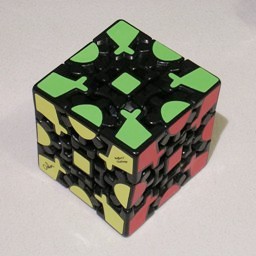
The Gear Cube was invented by Oskar van Deventer, based on an idea by Bram Cohen. It is like a 3×3×3 Rubik's Cube where all the edge pieces are cogs that turn when the outer layers are moved. If you give any face a half turn, the middle layer moves a quarter turn due to the edge cog wheels.
The puzzle is manufactured and sold by Uwe Meffert. It is quite an easy puzzle. On the standard version the edge pieces only have stickers on the rotating cog, but it is possible to put stickers on the non-rotating base part of the edge pieces to make it a little harder.
This puzzle should not be confused with the much harder Gear Cube Extreme, also known as the Anisotropic Gear Cube.
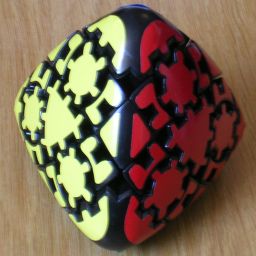
The Gear MasterMorphix is a tetrahedral version of the Gear Cube. It is slightly more difficult because the square pieces that are face centres on the cube are now edge centres, and so have two colours and visible orientation. In effect it is a 'supercube' variant of the fully stickered Gear Cube.
The pieces of the gear cube are very restricted in their movements, because
you can only do anti-slice moves. Instead of the centres, lets use a corner piece
as a fixed reference point. The corners split into two tetrads, which do not
mix. The locations of the three moving corners in the tetrad with the fixed
reference corner are fully determined by the locations of the four corners in
the other orbit. Those four other corners have 4! = 24 possible permutations.
The four edges in any slice will always remain in the same slice. Given a corner
permutation, it turns out that the edges in a slice can only be permuted in 4 ways.
They also all have the same twist, for which there are three possibilities.
The three slices therefore contribute a factor (4·3)3 to the number
of positions.
The centres can permute but this is fully determined by the edge permutation.
This gives a total number of positions of 4!(4·3)3 = 41,472.
If the edge bases also have stickers on them, then their orientation becomes visible. There are only 4 possible orientation arrangements these can have, making the total number of positions 4!(4·3)3·4 = 165,888. Note that this is 27 times the number of positions in the cube anti-slice group because of the 33 possible twists of the three edge slices.
The Gear MasterMorphix can have its edge-centres twisted. It turns out that without affecting any other pieces, opposing edge-centres must be twisted the same amount, and can only be twisted by half turns. As there are three opposing pairs, that means that the total number of possible positions is increased by a factor of 23, to make 4!(4·3)3·4·23 = 1,327,104.
I used my computer to calculate God's Algorithm for all three variations of the Gear Cube. Here are the results for the Gear Cube without stickers on the edge bases:
| Multiple turns | ||||||||||
|---|---|---|---|---|---|---|---|---|---|---|
| S i n g l e t u r n s |
0 | 1 | 2 | 3 | 4 | 5 | 6 | Total | ||
| 0 | 1 | 1 | ||||||||
| 1 | 6 | 6 | ||||||||
| 2 | 6 | 24 | 30 | |||||||
| 3 | 6 | 48 | 84 | 138 | ||||||
| 4 | 6 | 60 | 276 | 264 | 606 | |||||
| 5 | 6 | 72 | 540 | 1,218 | 264 | 2,100 | ||||
| 6 | 3 | 96 | 1,118 | 3,048 | 1,680 | 96 | 6,041 | |||
| 7 | 120 | 1,992 | 5,796 | 4,842 | 702 | 13,452 | ||||
| 8 | 108 | 1,610 | 5,721 | 4,650 | 1,189 | 13,278 | ||||
| 9 | 48 | 252 | 1,716 | 2,220 | 756 | 4,992 | ||||
| 10 | 3 | 36 | 306 | 285 | 144 | 774 | ||||
| 11 | 12 | 36 | 48 | |||||||
| 12 | 1 | 3 | 2 | 6 | ||||||
| Total | 1 | 33 | 579 | 5,921 | 18,072 | 13,977 | 2,889 | 41,472 | ||
This shows that if any number of turns of one face is considered as one move, then at most 6 moves are necessary (4.3032 on average). If each half turn of a face counts as two moves, then 12 moves are sometimes needed (7.3135 on average).
The antipodes are (see below for notation)
U6 R6 F6 (a 6X pattern)
R3 U6 F6 R3 (a 2X+4H pattern, occurs in 3 orientations)
U3 F3 R6 U6 F3 U9 (a 6H pattern, occurs in 2 orientations)
Here are the results for the Gear Cube with stickers on the edge bases:
| Multiple turns | ||||||||||||
|---|---|---|---|---|---|---|---|---|---|---|---|---|
| S i n g l e t u r n s |
0 | 1 | 2 | 3 | 4 | 5 | 6 | 7 | 8 | Total | ||
| 0 | 1 | 1 | ||||||||||
| 1 | 6 | 6 | ||||||||||
| 2 | 6 | 24 | 30 | |||||||||
| 3 | 6 | 48 | 96 | 150 | ||||||||
| 4 | 6 | 60 | 276 | 384 | 726 | |||||||
| 5 | 6 | 72 | 492 | 1,218 | 1,128 | 2,916 | ||||||
| 6 | 3 | 96 | 878 | 3,048 | 3,168 | 2,715 | 9,908 | |||||
| 7 | 120 | 1,632 | 4,872 | 11,382 | 6,024 | 2,724 | 26,754 | |||||
| 8 | 108 | 1,850 | 7,101 | 14,562 | 17,987 | 7,629 | 49,237 | |||||
| 9 | 48 | 756 | 4,152 | 14,556 | 18,870 | 7,920 | 2,832 | 49,134 | ||||
| 10 | 3 | 36 | 1,182 | 4,869 | 8,159 | 8,529 | 22,778 | |||||
| 11 | 12 | 276 | 1,620 | 1,020 | 1,044 | 3,972 | ||||||
| 12 | 1 | 3 | 2 | 258 | 264 | |||||||
| 13 | 12 | 12 | ||||||||||
| Total | 1 | 33 | 579 | 6,029 | 21,960 | 49,941 | 55,377 | 28,080 | 3,888 | 165,888 | ||
This shows that if any number of turns of one face is considered as one move, then 8 moves are necessary to solve the gear cube with extra stickers in the worst case (5.5263 on average). If each half turn of a face counts as two moves, then 13 moves are sometimes needed (8.2925 on average).
Finally, the results for the Gear MasterMorphix, or the Gear supercube:
| Multiple turns | ||||||||||||||
|---|---|---|---|---|---|---|---|---|---|---|---|---|---|---|
| S i n g l e t u r n s |
0 | 1 | 2 | 3 | 4 | 5 | 6 | 7 | 8 | 9 | 10 | Total | ||
| 0 | 1 | 1 | ||||||||||||
| 1 | 6 | 6 | ||||||||||||
| 2 | 6 | 24 | 30 | |||||||||||
| 3 | 6 | 48 | 96 | 150 | ||||||||||
| 4 | 6 | 60 | 276 | 384 | 726 | |||||||||
| 5 | 6 | 72 | 396 | 1,200 | 1,440 | 3,114 | ||||||||
| 6 | 3 | 96 | 512 | 2,346 | 4,176 | 4,554 | 11,687 | |||||||
| 7 | 96 | 660 | 3,108 | 11,016 | 11,088 | 10,686 | 36,654 | |||||||
| 8 | 72 | 852 | 4,599 | 15,630 | 29,409 | 25,444 | 16,677 | 92,683 | ||||||
| 9 | 72 | 828 | 4,716 | 21,630 | 47,706 | 51,462 | 38,616 | 18,840 | 183,870 | |||||
| 10 | 39 | 774 | 5,262 | 20,751 | 55,209 | 78,889 | 86,076 | 28,962 | 2,709 | 278,671 | ||||
| 11 | 672 | 3,840 | 20,100 | 51,480 | 80,208 | 84,180 | 66,696 | 1,440 | 308,616 | |||||
| 12 | 494 | 3,090 | 12,624 | 34,392 | 57,806 | 87,603 | 38,061 | 5,242 | 239,312 | |||||
| 13 | 288 | 1,464 | 6,510 | 13,200 | 34,176 | 35,964 | 32,370 | 768 | 124,740 | |||||
| 14 | 133 | 681 | 522 | 6,846 | 5,498 | 16,572 | 9,369 | 554 | 40,175 | |||||
| 15 | 48 | 144 | 240 | 1,992 | 648 | 2,946 | 384 | 6,402 | ||||||
| 16 | 60 | 108 | 72 | 27 | 267 | |||||||||
| Total | 1 | 33 | 579 | 6,029 | 30,690 | 114,543 | 254,124 | 346,221 | 366,444 | 197,316 | 11,124 | 1,327,104 | ||
So this puzzle can be solved in 10 moves (7.1446 on average), or 16 (10.609 on average) if each half turn of a face counts as two moves.
 Uwe Meffert's pages. He produces and sells the Gear Cube as well as many other puzzles.
Let F denote a clockwise half turn of the front face, keeping the rear face stationary. Similarly, let R and U denote clockwise half turns of the Right and Upper faces respectively.
Phase 1: Solve the corners.
Note that on the Gear MasterMorphix this phase will solve the 4 corners and the 4 triangular face centres.
Phase 2: Position the geared pieces.
In the cube these are the 12 edges, and on the tetrahedron these are the gears of which each face has three.
Phase 3: Orient the pieces.